

PolyWorks|DataLoop™ Three-Tier Architecture
PolyWorks|DataLoop requires that certain server applications be installed and configured. The following schema shows how PolyWorks® applications communicate with one another as well as with Microsoft SQL Server.
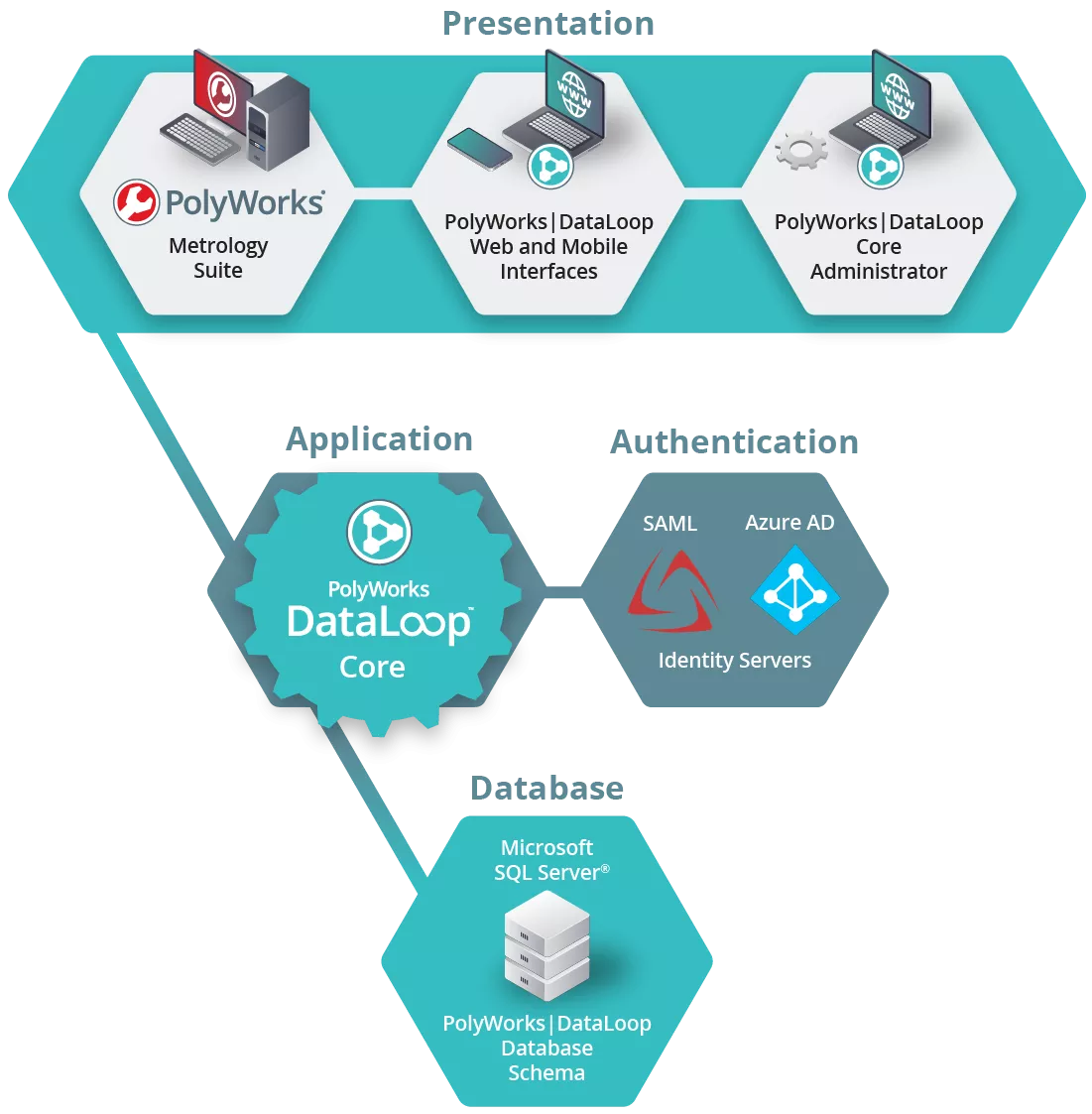
Server recommendations for PolyWorks|DataLoop
To use PolyWorks|DataLoop, a network infrastructure must be set up with potentially multiple servers. The number of servers and their configurations depend on the number of users that are expected to interact with the servers.
If you expect that up to 25 users will use PolyWorks|DataLoop, you can deploy all server applications and the database host on a single machine:
Machine configuration:
- Operating system: Microsoft Windows Server 2016a, 2019, 2022 and 2025
- CPU: 4 cores
- RAM: 16 GB
- Recommended cloud instances:
- Azure VM: B4ms: 4 vCPUs, 16 GB RAM
- Amazon VM: t3.xlarge: 4 vCPUs, 16 GB RAM
- Primary disk space:
- 500 GB on a solid-state drive (SSD) for the operating system, all components to install, as well as for the Microsoft SQL Server instance and the database files.b
- File storage:
- Microsoft Azure Blob Storage or Amazon S3 Storage (Recommended)
- FILESTREAM: At least 1 TB on a hard disk drive (HDD) for the Microsoft SQL Server FILESTREAM datab
- Components to install:
- Microsoft SQL Server 2017a or later
- Internet Information Services (IIS)
- SSL certificate - required for the HTTPS communication to the serverc
- Chrome 64-bit web browser
a. PolyWorks|DataLoop 2026 is the last version to support Microsoft Windows Server 2016 and SQL Server 2017.
b. The required size varies depending on the volume of data stored in the file system. A monitor software should be configured to send alerts when disk space is low.
c. SSL certificates issued from a well-known certification authority are recommended.
If you expect that up to 50 users will use PolyWorks|DataLoop, you can still deploy all server applications and the database host on a single machine but with increased capacity:
Machine configuration:
- Operating system: Microsoft Windows Server 2016a, 2019, 2022 and 2025
- CPU: 4 cores
- RAM: 32 GB
- Recommended cloud instances:
- Azure VM: E4as-v5: 4 vCPUs, 32 GB RAM
- Amazon VM: r7a.xlarge: 4 vCPUs, 32 GB RAM
- Primary disk space:
- 500 GB on a solid-state drive (SSD) for the operating system, all components to install, as well as for the Microsoft SQL Server instance and the database files.b
- File storage:
- Microsoft Azure Blob storage or Amazon S3 storage (Recommended)
- FILESTREAM: At least 4 TB on a hard disk drive (HDD) for the Microsoft SQL Server FILESTREAM datab
- Components to install:
- Microsoft SQL Server 2017a or later
- Internet Information Services (IIS)
- SL certificate - required for the HTTPS communication to the serverc
- Chrome 64-bit web browser
a. PolyWorks|DataLoop 2026 is the last version to support Microsoft Windows Server 2016 and SQL Server 2017.
b. The required size varies depending on the volume of data stored in the file system. A monitor software should be configured to send alerts when disk space is low.
c. SSL certificates issued from a well-known certification authority are recommended.
If you expect that 50 to 250 users will use PolyWorks|DataLoop with up to one million pieces across all projects, you must deploy server applications and the database host on two separate servers machines or managed platforms:
Application Server
- Operating system: Microsoft Windows Server 2016a, 2019, 2022 and 2025
- CPU: 4 cores
- RAM: 16 GB
- Recommended cloud instances:
- Azure VM: B4ms: 4 vCPUs, 16 GB RAM
- Amazon VM: t3.xlarge: 4 vCPUs, 16 GB RAM
- Primary disk space:
- 250 GB on a solid-state drive (SSD) for the operating system and all the components to install.
- Components to install:
- Internet Information Services (IIS)
- SSL certificate - required for the HTTPS communication to the serverb
- Chrome 64-bit web browser
a. PolyWorks|DataLoop 2026 is the last version to support Microsoft Windows Server 2016.
b. SSL certificates issued from a well-known certification authority are recommended. Note that the two servers must be on the same Windows domain for authentication using the Active Directory to work properly.
Database Host
- Required components: Microsoft SQL Server 2017a or laterbc
- CPU: 4 cores
- RAM: 32 GB
- Recommended cloud instances:
- Azure SQL Database: Hyperscale premium-series, memory-optimized: 4 vCOREs, 41.5 GB RAM
- Azure VM: E4as-v5: 4 vCPUs, 32 GB RAM
- Amazon RDS: db.r7i.xlarge: 4 vCPUs, 32 GB RAM
- Amazon VM: r7a.xlarge: 4 vCPUs, 32 GB RAM
- Primary disk space:
- Dynamically allocated storage or a minimum of 500 GB on a solid-state drive (SSD).
- File storage:
- Microsoft Azure Blob storage or Amazon S3 storage (Recommended)
- FILESTREAM (if used): At least 20 TB on a hard disk drive (HDD) for the Microsoft SQL Server FILESTREAM data.
a. PolyWorks|DataLoop 2026 is the last version to support SQL Server 2017.
b. We recommend that you do not install Microsoft SQL Server on a domain controller.
c. Microsoft SQL Server Enterprise Edition is recommended if 24/7 operation is required and no downtime is expected.
If you expect that 100 to 500 users will use PolyWorks|DataLoop with up to ten million pieces across all projects, you must deploy server applications and the database host on two separate machines or managed platforms:
Application Server
- Operating system: Microsoft Windows Server 2016a, 2019, 2022 and 2025
- CPU: 8 cores
- RAM: 32 GB
- Recommended cloud instances:
- Azure VM: B8ms: 8 vCPUs, 32 GB RAM
- Amazon VM: m7a.2xlarge: 8 vCPUs, 32 GB RAM
- Primary disk space:
- 500 GB on a solid-state drive (SSD) for the operating system and all the components to install.
- Components to install:
- Internet Information Services (IIS)
- SSL certificate - required for the HTTPS communication to the serverb
- Chrome 64-bit web browser
a. PolyWorks|DataLoop 2026 is the last version to support Microsoft Windows Server 2016
b. SSL certificates issued from a well-known certification authority are recommended. Note that the two servers must be on the same Windows domain for authentication using the Active Directory to work properly.
Database Host
- Required components: Microsoft SQL Server 2017a or laterbc
- CPU: 8 cores
- RAM: 128 GB
- Recommended cloud instances:
- Azure SQL Database: Hyperscale premium-series, memory-optimized: 12 vCOREs, 124.6 GB RAM
- Azure VM: E16as-v5: 16 vCPUs, 128 GB RAM
- Amazon RDS: db.r7i.4xlarge: 8 vCPUs, 128 GB RAM
- Amazon VM: r7a.4xlarge: 16 vCPUs, 128 GB RAM
- Primary disk space:
- Dynamically allocated storage or a minimum of 1 TB on a solid-state drive (SSD).
- Minimum disk throughput: 1,000 MB/s
- Minimum I/O operations per second (IOPS): 16,000
- File storage:
- Microsoft Azure Blob storage or Amazon S3 storage (required)
- FILESTREAM is not supported for databases of this size.
a. PolyWorks|DataLoop 2026 is the last version to support SQL Server 2017.
b. We recommend that you do not install Microsoft SQL Server on a domain controller.
c. Microsoft SQL Server Enterprise Edition is recommended if 24/7 operation is required and no downtime is expected.